GEO scores explained: what the number can tell you
Understand what a visibility score counts, how stable it is, and how research helps distinguish an observed ranking from a reliable business conclusion.

Updated
Read a GEO score by checking the event it counts, the questions and samples behind it, and how much the answers vary. Mentions, recommendations, citations and visits describe different outcomes. GEO50 combines confirmed brand signals into a ranking for a defined observation; interpreting a change also requires comparable conditions and the underlying evidence.
What to take away
- Identify the event and denominator before comparing scores.
- Use repeated answers and source checks to assess reliability.
- Treat the ranking as evidence for a decision, not a measure of product quality or a proven effect of an edit.
Begin with the decision the score should support
A brand’s score rises after a website update. The immediate temptation is to call the update successful. Before doing so, ask what changed in the underlying answers: did the brand appear more often, receive stronger recommendations or gain links to its website? Those are different improvements.
A useful measurement starts with a question such as “Do relevant AI answers recommend our product for this customer need?” The question determines which prompts to collect, which event to count and which comparison would matter. The 2026 critical survey makes this explicit: define the intended outcome, denominator and meaningful difference before collecting data.
Separate presence from preference and citation
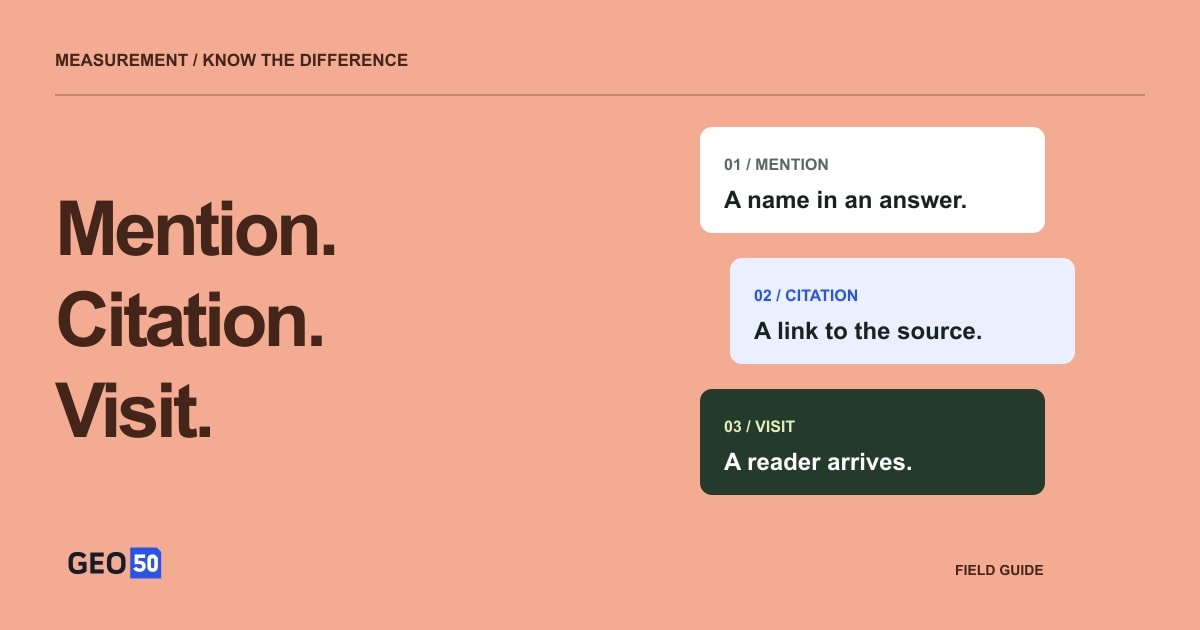
An answer saying “Acme is one of several scheduling tools” establishes a mention. “Acme is a suitable choice for this agency” adds a recommendation. “Acme is my first choice for these requirements” expresses a stronger preference. A source link is a separate event and may point to the company, an independent review or a competitor.
| Event | What the evidence must show |
|---|---|
| Mention | The brand is named in the answer |
| Recommendation | The answer proposes the brand as a suitable choice |
| First choice | The answer explicitly identifies it as the top choice |
| Website citation | A link points to the company’s own page |
This distinction also explains why research results cannot be compared using the headline alone. C-SEO Bench evaluates changes in citation order; that outcome is different from how often a brand is named or explicitly recommended. In an automated report, review a sample of the original answers to check that the labels match the language. A brand name in a URL or a product appearing first in a list is insufficient evidence of an explicit first-choice recommendation.
Check what a citation actually supports
A link makes an answer inspectable, but does not establish that the linked page supports the claim. In their 2023 study of generative search engines, Liu, Zhang and Liang audited Bing Chat, NeevaAI, Perplexity and YouChat. Across the systems they evaluated, 51.5% of generated statements were fully supported by citations, while 74.5% of citations supported their associated statements. These are historical audit results, not estimates of today’s platform accuracy.
The two figures address different questions. Citation recall concerns whether statements that need verification have full source support. Citation precision concerns whether the attached citations support what the answer says. Both require examining the sources, rather than counting links.
Suppose an answer says a product works offline and includes free onboarding. A page confirming offline use supports only part of that sentence. Check the other claim, the applicable plan and the date before treating the answer as accurate. Even complete source support is a test of attribution, not proof that the source itself is true. For a business, the practical review is whether its capabilities and conditions survive the retelling.
Make the denominator visible
Imagine 20 collection attempts produce 16 usable answers, four of which cite the company’s website. The citation rate among usable answers is 4/16, or 25%; collection success is 16/20, or 80%. These hypothetical figures describe two different things. Reporting only “25% visibility” conceals the collection failures and leaves the event undefined.
A completed answer with no brand mention is also different from a failed request. The first is an observed absence; the second is missing evidence. Record them separately and state which observations enter each metric.
Question selection matters just as much. “Is Acme a good scheduling tool?” tests a response to a named brand. “Which tools suit a small agency?” tests discovery within a category. Mixing these without distinction can change the score simply by changing the questions. Generated questions form a test set; they do not measure how frequently real customers ask each question.
Expect variation between answers
Don’t Measure Once, a 2026 preprint, examined four AI search engines using observations over time and repeated runs. In its within-24-hour source analysis, average Jaccard overlap ranged from about 32% to 43% across the four campaign categories. Jaccard overlap compares the shared sources with the union of the two source sets; it is not a brand’s mention rate or a probability that an answer is correct.
The analysis used up to ten repeats per engine–prompt and excluded runs with no extracted citations from that source comparison. The collection context was Swiss, and selected sectors and brand-detection rules further limit generalization. Its useful finding is that a second answer can differ substantially even without a long time interval or a website edit.
That suggests three separate checks: repeat the identical question to examine run-to-run variation, use equivalent phrasings to examine wording sensitivity, and repeat a fixed question set over time to examine change. A result that survives all three is more informative than one favorable screenshot.
How GEO50 turns brand signals into a score
GEO50 summarizes confirmed brand signals in sampled, single-turn AI answers. Its current formula is our scoring policy, rather than a formula prescribed by the papers cited here. Website citations, referral visits and citation quality are outside this score.
| Signal | Contribution |
|---|---|
| Brand appears in the answer | 20 × mention rate |
| Brand is explicitly recommended | 50 × recommendation rate |
| Brand is explicitly a first choice | 30 × first-choice rate |
| Brand is explicitly not recommended | −50 × non-recommendation rate |
Use rates from 0 to 1, add the contributions and limit the result to 0–100. First choice is a subset of recommendation and receives additional weight. List order, bold text or repetition alone does not establish first choice, and several products from the same brand in one answer do not earn extra points.
For ten hypothetical, equally weighted answers, a brand mentioned neutrally in all ten scores 20. A brand recommended in three, absent in seven and never identified as first choice scores 21: 20 × 0.3 + 50 × 0.3. The difference reflects the scoring policy’s emphasis on recommendation; neither number is a purchase probability.
Repeated samples are averaged within each question–platform combination, and those combinations receive equal weight. A complete answer naming no brands remains in the denominator. All planned samples must be valid and analyzed under a compatible method before scores and ranks are displayed. Incomplete collection is not assigned zero, and the earlier 4/16 citation example does not qualify an observation for a GEO50 ranking.
Ambiguous or conflicting recommendations retain an uncertain judgment rather than an assumed positive or negative signal. The score therefore summarizes confirmed signals under this policy. It is not a confidence level, a market-share estimate or a product-quality rating.

GEO50’s current scoring policy, checked against the implementation. First choice adds weight to a recommendation; ambiguous signals remain uncertain. This is not a formula prescribed by the cited papers. View full-size diagram.
Compare observations on the same terms
A higher score becomes informative when the comparison preserves the meaning of the measurement. The survey’s proposed research protocol combines repeated measurements, paraphrases, controls and human validation. It also notes that answers are clustered by questions, sources and dates: treating every output as an independent customer preference can understate uncertainty. Martinez
For a business report, keep a compact comparison record:
| Dimension | Keep visible |
|---|---|
| Questions | Exact wording, customer intent and selection method |
| Conditions | Platform, product surface, language, intended market and time |
| Samples | Planned, usable and failed observations for each question and platform |
| Change | Page versions, intervention date and an untreated comparison where feasible |
| Evidence | Original answers, source URLs and checks of automated judgments |
Use a pilot to assess variability and choose sampling depth for the decision. Increasing the count without improving question coverage or collection consistency can still produce a misleading result. GEO50’s current ranking does not display statistical confidence intervals or establish the causal effect of an edit.
Use the ranking to decide what to investigate
A weak result for a relevant customer need can direct attention to missing product facts, unclear positioning or stronger competing answers. A stronger result can identify an explanation worth maintaining. Review the actual answers before deciding which action follows, and compare observations with their question set and scoring method in view.
Keep the business context separate from what was technically verified. Selecting a market expresses the intended buying context; it does not by itself reproduce a local user’s environment. Google’s AI-feature traffic is included in overall Web reporting in Search Console, so that total is not a standalone count of AI citations. Website analytics and customer inquiries add further evidence about business outcomes. Google Search Central
GEO50 shows the observation scope and collection completeness, and its current download contains the completed ranking rather than the full answer archive. Use it to locate patterns worth examining, then follow the evidence into the answers and customer experience. Our website preparation guide explains how to turn a finding into a defined content improvement.
Sources & editorial note
- Google Search Central — AI features and your website ↗
Official guidance for Google AI Overviews and AI Mode; checked October 18, 2026. Platform requirements, not an experimental study.
- Schulte, Bleeker & Kaufmann — Don’t Measure Once: Measuring Visibility in AI Search (GEO) ↗
2026 preprint, arXiv v1, April 8. Sections 3–6: longitudinal and repeated-run source/brand overlap across four engines. Swiss collection context, selected campaign verticals, substring-based brand detection and filtering limit generalization.
- Liu, Zhang & Liang — Evaluating Verifiability in Generative Search Engines ↗
Findings of EMNLP 2023; arXiv v2, October 23, 2023. Sections 2.3–2.4 and 4.2, plus Limitations: citation recall, citation precision and the difference between source support and factual truth. Historical audit, not a current platform scorecard.
- Martinez — Optimizing Visibility in Generative Engines: A Critical Survey of Generative Engine Optimization (2023–2026) ↗
2026 survey preprint, arXiv v1, July 15. Synthesis of 45 studies; Sections 3, 6 and 11 distinguish pipeline stages, visibility outcomes and measurement design. Use as a research synthesis, not independent experimental confirmation.
- Puerto et al. — C-SEO Bench: Does Conversational SEO Work? ↗
NeurIPS 2025, Datasets and Benchmarks Track. Sections 4 and 6–7: two tasks, six domains, citation ranking and competing adopters. English-language benchmark; context-order experiments do not demonstrate a way to obtain that order on a live engine.