How to prepare your website for AI search
A research-informed workflow for making business pages accessible, relevant and verifiable, with a clear way to evaluate the results.

Updated
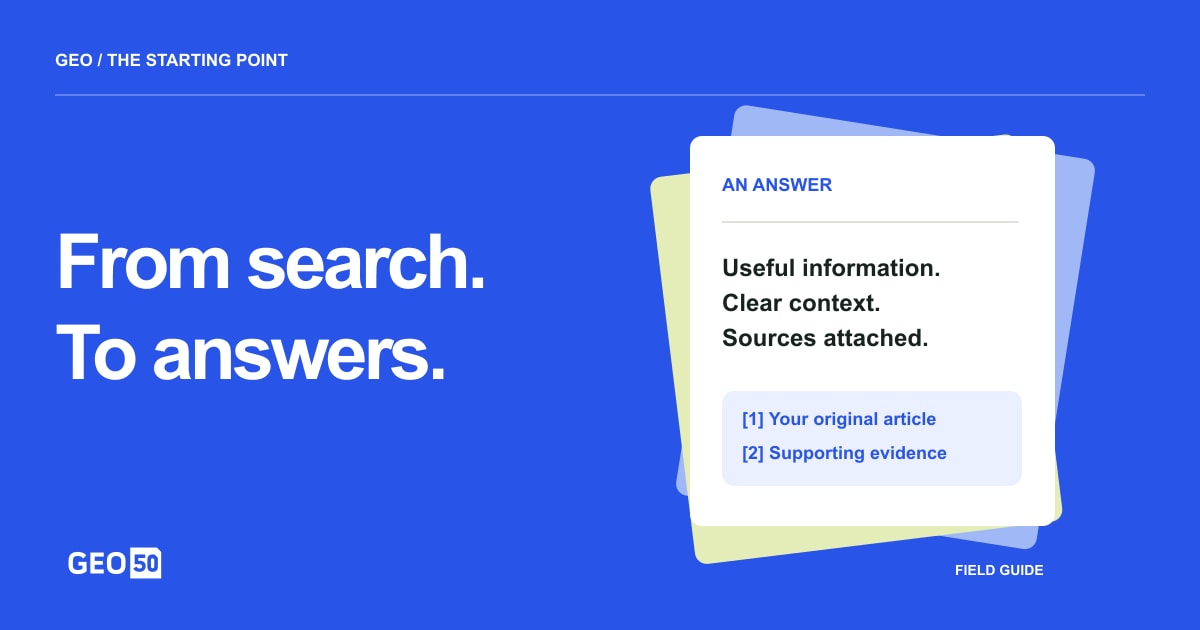
Prepare for AI search by making the right page accessible, answering a real customer question and supporting the answer with specific evidence. Keep the page’s title, content and metadata consistent, connect it to related information, and verify both publication and subsequent AI answers. Each step addresses a different part of the discovery-to-answer process.
What to take away
- Keep customer needs and familiar language at the center of the page.
- Put evidence and its conditions beside the claim it supports.
- Check access and content first, then evaluate AI visibility against a baseline.
1. Give the answer a page that can be found
Consider a scheduling-software company whose customers ask about bookings across time zones. The answer may already exist, scattered across a help article, a pricing page and a sales presentation. The first task is to give that question a stable, useful destination on the website.
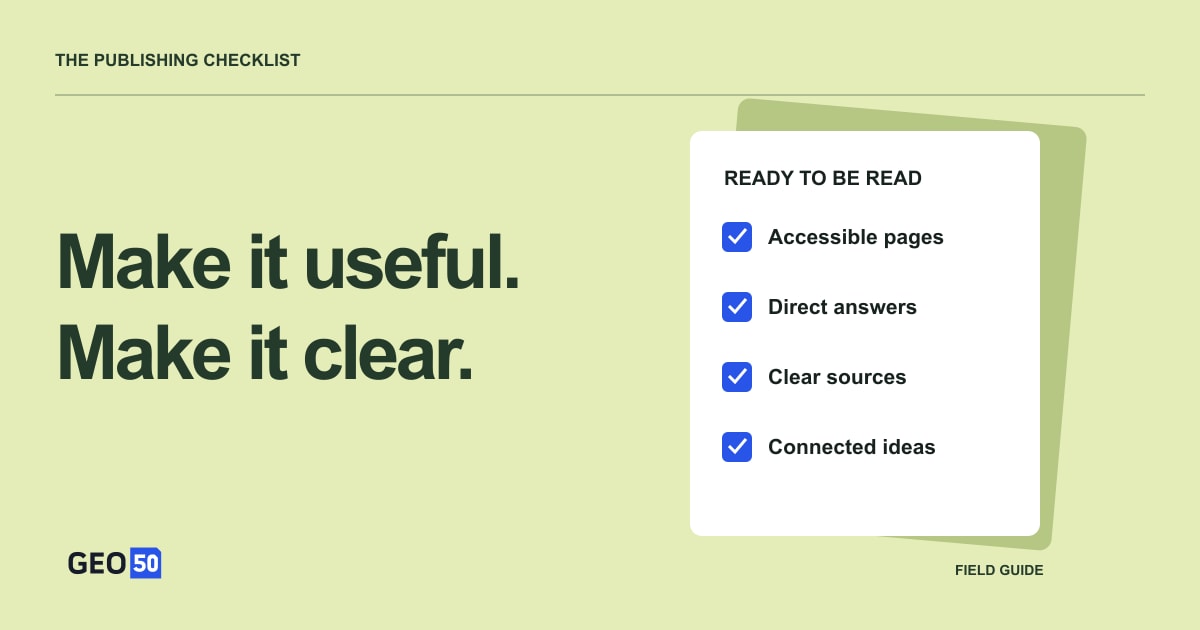
Check that the intended URL returns the page, works without a login and has no accidental noindex directive. Review robots rules together with hosting and CDN restrictions. Important information should be available as text; placing the core answer in the initial HTML also makes it easier to inspect and reduces rendering dependencies.
For Google AI Overviews and AI Mode, a supporting page must be indexed and eligible for a snippet. Search Console can help check a deployed URL’s indexing status. A working preview or an entry in a sitemap does not establish that the page is indexed. Google Search Central
Find the weak stage
SAGEO Arena helps explain why access is only the beginning. Its experimental pipeline retrieves documents, reranks them and passes a limited selection to the generator. The researchers report that 5.8% of target documents dropped from position 10 to 11 during reranking, missing that pipeline’s generation threshold. The cutoff belongs to the experiment, but the lesson is practical: a small change before generation can decide whether content is available to the answer at all.
Investigate in that order. If the page is inaccessible, fix access. If it is accessible but poorly aligned with the question, improve relevance. If an answer cites the page but misstates it, examine the wording and evidence. Each problem calls for a different edit.
2. Organize the page around the customer’s question
Once the destination works, decide what a reader should learn in the first paragraph. For the scheduling example, explain how the product handles time zones, which calendars it supports and where limitations apply. Follow that answer with configuration steps, exceptions and links to the relevant product documentation.
Keep ordinary customer language in the title, headings and explanation. SAGEO Arena found that some rewrites using unusual or technical vocabulary harmed retrieval; its case analysis also favored topical alignment and answers placed early in the document. These results come from a controlled pipeline, but they give a useful reason to resist vague, inflated copy. Kim et al.
A heading such as “How bookings handle time zones” tells readers more than “A new era of intelligent coordination.” The rest of the page should develop the same promise. If a section introduces an unrelated use case, move it to a page where that question is central.
3. Make the answer worth trusting
Clarity gets a claim understood; evidence lets it be checked. The original GEO experiments found visibility gains from some additions of quotations, statistics and citations. The useful publishing response is to supply stronger evidence for a relevant claim, rather than increase the number of references indiscriminately.
For a product page, evidence may be a maintained specification, a help document, a dated test or a comparison with a stated method. For a research article, it may be the original paper and the section containing the result. Keep units, dates, sample descriptions and product versions close to any number that depends on them.
Build a claim that can be verified
Use a simple review: what would a reader need to open or inspect to confirm this sentence? A hypothetical scheduling page might need the following:
| Customer question | Information to provide | Evidence to connect |
|---|---|---|
| Does it work with our calendar? | Supported services and any plan restrictions | Current integration documentation |
| Will clients see the right time? | Time-zone behavior and daylight-saving exceptions | Documented behavior or a reproducible test |
| What will the team pay? | Billing period, seat rules and applicable charges | The current pricing page |
| Is it better for our workflow? | Named alternatives and consistent comparison criteria | Dated observations with an explained method |
Check the whole claim, including its conditions. A document that confirms offline access does not also establish free onboarding. The verifiability study published in Findings of EMNLP 2023 distinguishes the presence of citations from whether they support the associated statements. That principle is as useful when editing your own page as when reviewing an AI answer.
If the evidence supports a narrower conclusion, write the narrower conclusion. Show an accurate author or team identity and record material updates so a reader can assess who is responsible and how current the information is.

An editorial structure for a verifiable page, not a guarantee of AI inclusion. See Google’s guidance and the research on citation support. View full-size diagram.
4. Connect the page to the rest of the decision
A useful answer rarely completes the whole buying journey. The time-zone guide should help a reader reach integration details, pricing and setup instructions. Those pages should also provide a sensible route back to the guide when the question arises.
Use descriptive text links and include canonical pages in the sitemap. Google identifies internal discoverability as part of the foundations for its AI features. Google Search Central For readers, the same structure reduces the effort of checking a claim or taking the next step.
This gives a small website a clear publishing plan. Add a new page when a distinct customer question needs a substantive answer. Keep closely related explanations together when separating them would create repetition or hide essential qualifications.
5. Keep the page’s identity consistent
The title, summary, visible answer and structured data should describe the same thing. For the scheduling guide, use the actual subject in the title and description, select the intended canonical URL, and keep author and date information aligned with the article.
SAGEO Arena found that organizing relevant entities and facts in structural fields helped retrieval compared with its body-only optimization setting. This supports attention to clear page identity; it does not establish a universal schema-based ranking boost. Google separately states that no special AI schema is required, and that structured data should match visible content. SAGEO Arena · Google Search Central
Give informative images descriptive alternative text, and keep essential conclusions in readable text. Metadata should make the page easier to recognize and interpret, while the page itself supplies the promised answer.
6. Verify the page, then observe the outcome
After publishing, open the actual public URL. Read the delivered content, follow its links, inspect the mobile layout and check indexing information where available. This verifies things the company controls. Whether an AI system retrieves, cites or recommends the page is a separate observation.
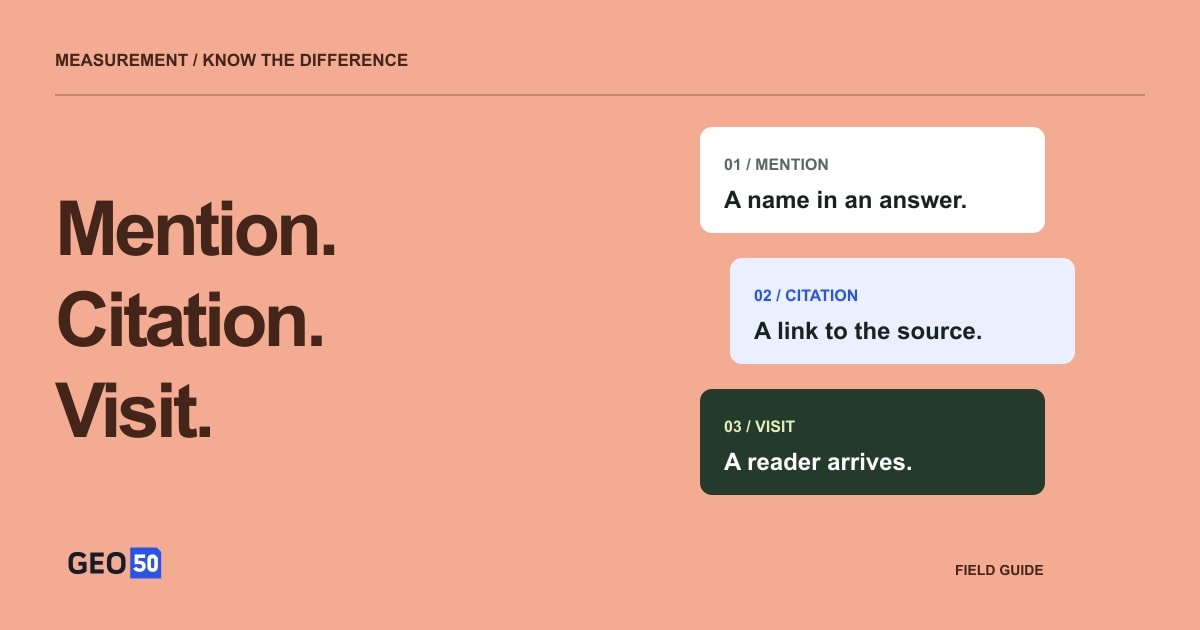
Save the page version and publication date. Record a fixed set of relevant customer questions, the platforms and collection conditions, then retain the answers and source links. Measure website visits separately from citations so that one does not stand in for the other.
Evaluate a specific change
C-SEO Bench found that many content modifications did not improve citation ranking, and that gains could shrink as more competitors adopted the same method. This makes a defined comparison more valuable than a broad claim that the site has been “AI optimized.”
For example, test whether adding a documented explanation of time-zone behavior changes how answers describe that capability. Keep the questions and collection method comparable, repeat observations, and retain an unchanged comparison group where feasible. Record other changes that could affect the result. A before-and-after difference alone cannot separate the effect of the edit from platform or competitor changes.
The workflow ends with a decision: keep an improvement because it helps customers and has supporting observations, revise it because it introduces confusion, or collect more evidence when the result is unclear. Our measurement guide explains how to make that judgment from the answers and scores.
Sources & editorial note
- Google Search Central — AI features and your website ↗
Official guidance for Google AI Overviews and AI Mode; checked October 18, 2026. Platform requirements, not an experimental study.
- Aggarwal et al. — GEO: Generative Engine Optimization ↗
KDD 2024; arXiv v3, June 28, 2024. Sections 3–4 and 9: experimental setup, visibility results and limitations. Gains concern the tested visibility metrics, not website visits or sales.
- Puerto et al. — C-SEO Bench: Does Conversational SEO Work? ↗
NeurIPS 2025, Datasets and Benchmarks Track. Sections 4 and 6–7: two tasks, six domains, citation ranking and competing adopters. English-language benchmark; context-order experiments do not demonstrate a way to obtain that order on a live engine.
- Kim et al. — SAGEO Arena: A Realistic Environment for Evaluating Search-Augmented Generative Engine Optimization ↗
arXiv v2, August 7, 2026; author record states accepted at KDD 2026. Sections 3 and 5, Appendix D: retrieval, reranking, generation and limits of reproducing commercial engines.
- Liu, Zhang & Liang — Evaluating Verifiability in Generative Search Engines ↗
Findings of EMNLP 2023; arXiv v2, October 23, 2023. Sections 2.3–2.4 and 4.2, plus Limitations: citation recall, citation precision and the difference between source support and factual truth. Historical audit, not a current platform scorecard.