What is GEO? What AI search research means for businesses
How brands enter AI answers, what optimization experiments have found, and how to turn those findings into a practical business strategy.

Updated
GEO is the work of improving how a business’s information is discovered, represented and used in AI-generated answers. Research shows that content changes can affect visibility, but the result depends on retrieval, the task and the metric being measured. A useful strategy connects accessible pages and verifiable information with repeated observation of real customer questions.
What to take away
- Distinguish being discovered, cited or recommended from receiving visits.
- Read research results together with their experimental setup and metric.
- Start with a customer decision, improve the evidence, then measure the change.
AI search changes where customers meet a brand
A customer asks an AI service which scheduling tool suits a small agency. The answer compares several products, explains their trade-offs and recommends a shortlist. A brand can become part of that decision before the customer opens any company website.
This is the business problem behind generative engine optimization, or GEO: how can a company make its information available and useful when a system assembles the answer? The work includes helping relevant pages be discovered, making product facts clear, and checking whether the resulting answer represents the business accurately. A mention is one possible outcome; a supported recommendation or a useful visit is another.
The GEO paper presented at KDD 2024 gave this problem an experimental framework. It studied whether changing source content could change its visibility in generated answers. Understanding what happens before an answer is written explains both the promise of that work and its limits.
SEO remains the foundation
An answer cannot reliably draw on a page that its search system cannot find or access. For Google AI Overviews and AI Mode, the official requirement is straightforward: a supporting page must be indexed and eligible to display a snippet. Google continues to recommend crawl access, useful internal links, important information in text and structured data that matches the visible page. It requires no special AI file or additional schema for these features. Google Search Central
For the scheduling company, that means its product, pricing and integration pages still need stable URLs and accessible content. Calling this work GEO does not remove the need for SEO. The additional question is what the system does with the information after finding it: which facts it selects, which sources it cites and which products it recommends.
A page passes through several decisions
For search-enabled answers, the path from website to recommendation can be understood as four stages. Not every platform exposes these stages, and some answers are generated without web search.
| Stage | What the system does | What the business needs to understand |
|---|---|---|
| Discovery and indexing | Finds and makes pages available for search | Can the intended page be accessed and indexed? |
| Retrieval | Finds material related to the question | Does the page clearly address the customer’s need? |
| Selection | Ranks material and fits it into the available context | Does relevant information survive the selection process? |
| Answer generation | Combines information into an answer, sometimes with citations | Is the business represented accurately and usefully? |
SAGEO Arena studies this chain using a corpus of about 170,000 web documents across nine domains. Its experiments include retrieval and reranking before generation. The researchers found that some body-text rewrites harmed those earlier stages, particularly when familiar query terms were replaced with unusual vocabulary or the text drifted away from the original topic.
That result changes the diagnosis of a missing citation. A passage may be easy to quote yet never reach the generator. Before rewriting it again, a business needs to investigate access, relevance and selection as well as the final answer.

A simplified model for search-enabled answers. Actual stages vary by platform; some answers do not use web search. See Google’s guidance and SAGEO Arena. View full-size diagram.
What content-optimization experiments have found
The original GEO study found that adding relevant quotations, statistics and citations could improve visibility in its experiments, with the paper reporting gains of up to 40%. Its main setup supplied five retrieved sources to GPT-3.5 Turbo and generated five responses per query to reduce variation. The metrics considered how much of an answer was associated with a source, its position and other aspects of visibility. The reported gain concerns those metrics under the tested conditions; it is not a measured increase in customers or revenue. Aggarwal et al.
C-SEO Bench, published at NeurIPS 2025, examined a different outcome: whether an edited document was cited earlier. Across question answering and product recommendation in six domains, most tested methods produced no significant gain, and some reduced citation rankings. The authors report that the statistics-addition method lowered rankings in 19 of 24 evaluated settings. Gains from the best-performing methods also declined as more competing documents adopted them.
These findings do not collapse into a universal rule that “adding citations works” or “GEO does not work.” A source occupying more answer space and a source being cited earlier are different outcomes. The models, tasks and competitive settings also differed. SAGEO Arena adds another condition: the edited page must remain competitive during retrieval and selection. Together, the studies support testing relevant content improvements across the full process, rather than treating a writing technique as a guaranteed ranking mechanism.
Connect visibility to the business outcome
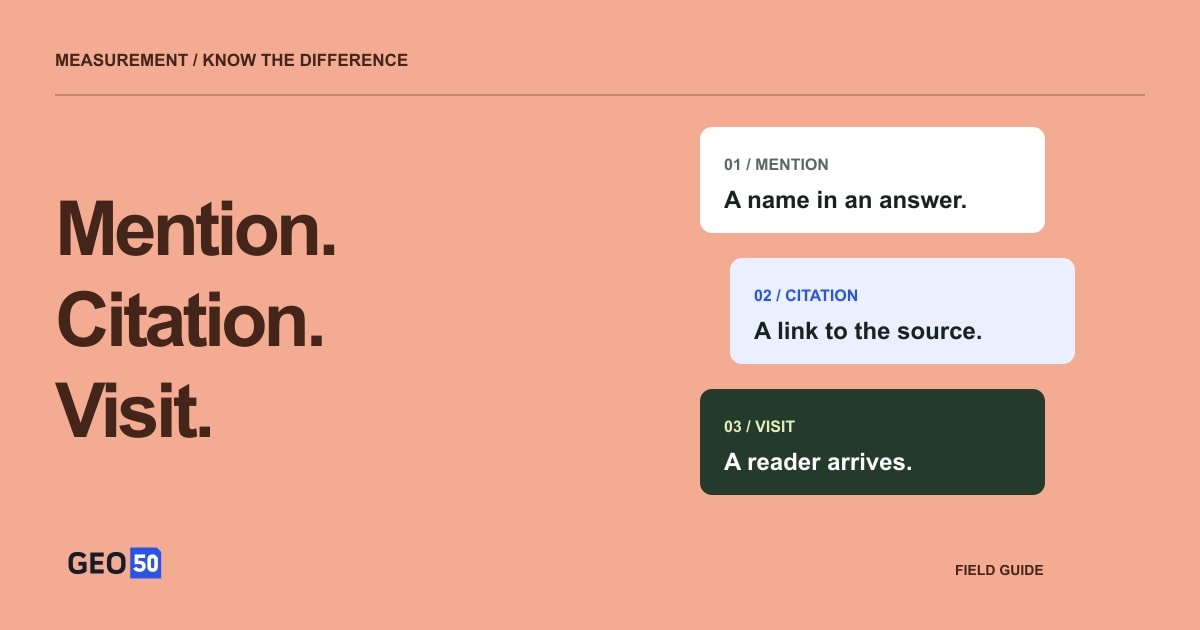
Suppose an AI answer recommends the scheduling company but cites an independent review. The brand has earned a recommendation; its own website has not earned a citation. If the answer links to the company’s integration guide and nobody clicks, the website has earned a citation without an observed visit.
The 2026 critical survey of GEO research separates discoverability, citation, information use and economic outcomes. For a business, that distinction becomes a simple reporting discipline:
| Outcome | What to record |
|---|---|
| Brand presence | Whether the answer names or recommends the brand |
| Website citation | Whether it links to a page on the company’s domain |
| Accurate representation | Whether the answer preserves the relevant facts and conditions |
| Business response | Visits, qualified inquiries or other useful actions that can actually be observed |
A campaign can improve one outcome without improving the others. Choosing the intended outcome first makes the subsequent investment and measurement more useful.
Start with one customer decision
For our scheduling example, “Which tool supports client bookings across time zones?” is a more useful starting point than “How can we appear more often in AI?” It identifies a reader, a task and the evidence that could help: supported workflows, calendar integrations, limitations and current pricing.
Build a page that answers that question directly. Use the terms customers recognize, make comparisons on consistent criteria, and link factual claims to documentation or clearly described tests. A sourced explanation of a real limitation may help a buyer more than another paragraph claiming that the product is the best.
This is the practical direction we take from the research: improve the information available for a decision, then test how it is represented. Our website preparation guide turns that approach into a publishing workflow.
Establish a baseline before expanding
Choose a defined set of customer questions and record the platforms, language, intended market and observation window. Keep the answers and source links, then repeat the observations under comparable conditions. The survey’s measurement recommendations emphasize these records, along with controls and human checks, because a favorable answer on one occasion is a weak basis for a lasting claim. Martinez
Use that baseline to decide what to improve next: a missing product fact, an unclear comparison or a page that is difficult to discover. Over time, assess brand visibility alongside website behavior and customer feedback. The GEO score guide explains how to interpret the resulting numbers and how GEO50’s ranking fits into that wider picture.
Sources & editorial note
- Google Search Central — AI features and your website ↗
Official guidance for Google AI Overviews and AI Mode; checked October 18, 2026. Platform requirements, not an experimental study.
- Aggarwal et al. — GEO: Generative Engine Optimization ↗
KDD 2024; arXiv v3, June 28, 2024. Sections 3–4 and 9: experimental setup, visibility results and limitations. Gains concern the tested visibility metrics, not website visits or sales.
- Puerto et al. — C-SEO Bench: Does Conversational SEO Work? ↗
NeurIPS 2025, Datasets and Benchmarks Track. Sections 4 and 6–7: two tasks, six domains, citation ranking and competing adopters. English-language benchmark; context-order experiments do not demonstrate a way to obtain that order on a live engine.
- Kim et al. — SAGEO Arena: A Realistic Environment for Evaluating Search-Augmented Generative Engine Optimization ↗
arXiv v2, August 7, 2026; author record states accepted at KDD 2026. Sections 3 and 5, Appendix D: retrieval, reranking, generation and limits of reproducing commercial engines.
- Martinez — Optimizing Visibility in Generative Engines: A Critical Survey of Generative Engine Optimization (2023–2026) ↗
2026 survey preprint, arXiv v1, July 15. Synthesis of 45 studies; Sections 3, 6 and 11 distinguish pipeline stages, visibility outcomes and measurement design. Use as a research synthesis, not independent experimental confirmation.